
Complex Musculoskeletal Assessment

Our Complex Musculoskeletal Assessment is recommended in the following cases:
Health preservation – prevention of spine and joint problems
Pain – lower back, upper back or neck pain
Restricted mobility – decreased joint range of motion
Postural problems – Scheuermann’s disease, increased lordosis, kyphosis
Degenerative spinal conditions – spondylosis, spondylolisthesis, disc herniation
Temporomandibular joint (TMJ) disorders – joint pain and stiffness, clicking, facial pain, tinnitus, headaches
Prior to lymphatic drainage massage
During pregnancy – from the 2nd trimester – Written consent from the obstetrician-gynecologist is required to participate in prenatal physiotherapy exercises or manual therapy.
After childbirth – if you prefer not to undergo EMG pelvic floor examination
Pelvic complaints – if you do not wish to have an EMG pelvic floor examination
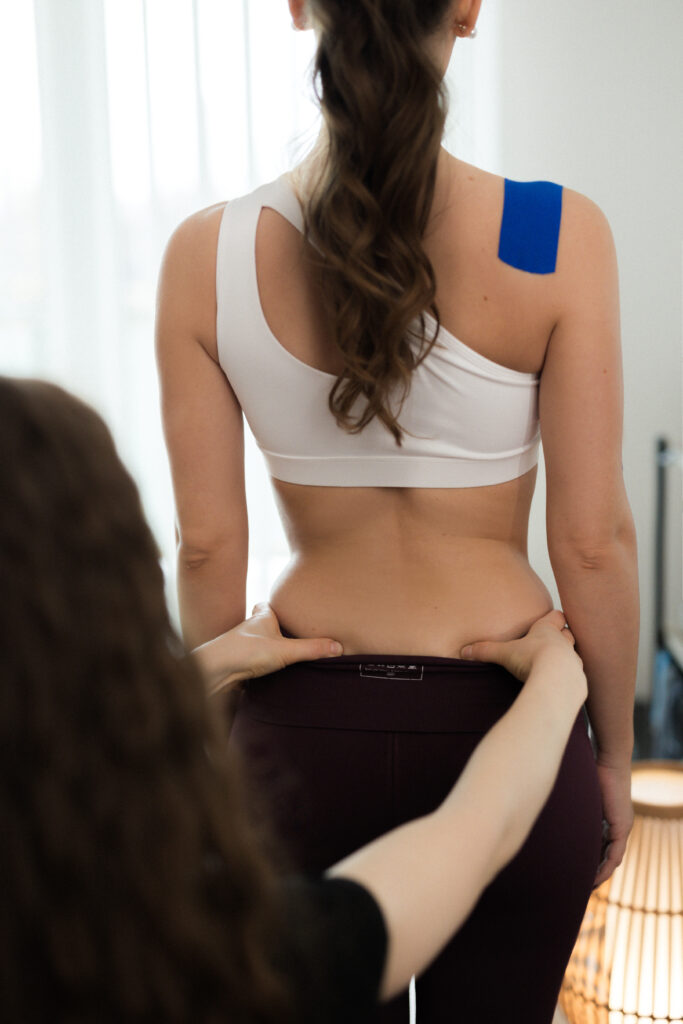
Physiotherapy Assessment Process
If you arrive with musculoskeletal complaints, the assessment includes:
Medical history – Nature and duration of symptoms, aggravating/relieving factors, lifestyle, stress, physical load, previous imaging results, medical reports, treatment outcomes, and patient goals.
Posture, spine and hip mobility assessment – Performed in underwear or shorts.
Foot arch assessment – Evaluation of foot structure and biomechanics.
Segmental spinal examination – Assessment of mobility and alignment of individual spinal segments.
Examination of symptomatic joints and soft tissues
Palpation of connective tissues and muscles
Special physiotherapy and functional tests
Summary and treatment plan – Development of a personalized physiotherapy plan and lifestyle recommendations.

If You Are Pregnant or Postpartum
We welcome pregnant women from the 2nd trimester and mothers after childbirth following the 6-week medical check-up.
Even in the absence of symptoms, or if you wish to attend prenatal physiotherapy classes: please choose this service first!
Medical history – Nature and duration of symptoms, lifestyle factors, stress, medical history, imaging, previous treatments, and personal goals.
Posture, spine and hip mobility, and diaphragm function assessment – Performed in underwear.
Foot arch assessment – Evaluation of foot structure and biomechanics.
Assessment of lumbar and hip soft tissues – Through palpation and physiotherapy tests, typically in side-lying position.
Diastasis recti examination and C-section scar assessment (with mothers)
6. Pelvic floor functional assessment – recommended but not mandatory
The pelvic floor assessment includes visual inspection, palpation, and functional tests. It is always performed with the patient’s consent, in a discreet setting, and the patient may wear a medical skirt. Patients may be accompanied by a companion.
Patient positioning: usually lying on the side or supine with legs bent.
The physiotherapist first inspects the symmetry and skin condition of the perineal and anal area. If there are signs of skin injury or infection, the internal assessment is not performed.
During the assessment, the physiotherapist uses gloves and a small amount of lubricant to palpate the pelvic floor muscles internally, via the vagina or rectum, to assess baseline muscle tone.
Next, the patient performs various pelvic floor muscle activation tasks under the physiotherapist’s guidance. The specialist evaluates:
Muscle strength
Ability to relax
Coordinated function
Symmetry or possible asymmetry of muscle activation
The physiotherapist also monitors posture, diaphragm movement, and any involvement of accessory muscles.
Functional assessment includes evaluating pelvic floor muscle activation and coordination during daily activities, such as coughing, bearing down, or squatting, while continuing to monitor reflexive and voluntary muscle function through palpation.
The patient can indicate at any time if they experience pain or discomfort, and the assessment can be stopped at any time.
Summary and physiotherapy treatment plan

If you arrive for temporomandibular (jaw) joint therapy, the assessment includes:
Medical history (location and onset of the pain, onset of clicking, aggravating / relieving factors, lifestyle, previous imaging, medical reports, results of earlier treatments, the patient’s goals)
Assessment of the relationship between the cervical spine and the jaw / headache (mouth opening tested in different neck positions, cervical functional tests, neck muscle strength tests). Blood pressure is measured in every case, for safe treatment.
Measurement of the vertical and horizontal overlap of the upper and lower incisors, and of the midline deviation between the two dental arches
Patterns of mouth opening (straight, deviation, deflection)
Assessment of mouth opening (in mm: pain-free opening, maximum opening, maximum assisted opening, end-feel)
Assessment of lateral and forward movement of the jaw joint (in mm, location of pain)
Examination of the sounds produced during movement (clicking / crepitus, whether pain occurs, locking)
Palpation of the masticatory muscles (externally)
Palpation of the temporomandibular joint (externally)
Establishing a functional diagnosis (straight, deviation, deflection)
painful conditions – e.g. muscle pain, myofascial pain with referral, temporomandibular joint pain, headache caused by jaw problems
joint dysfunctions – clicking jaw, intermittent locking, chronic disc displacement, jaw hypermobility (subluxation)
degeneration of the temporomandibular joint cartilage
Summary: drawing up a physiotherapy plan and discussing other medical and therapeutic options

If You Arrive for Lymphatic Drainage Massage
Medical history – Symptom characteristics, lifestyle, stress, prior imaging and medical reports, treatment outcomes, and patient goals.
Blood pressure measurement before treatment – Performed in every case to ensure safety.
Manual lymphatic drainage massage – A personalized, gentle, rhythmic technique to support lymphatic circulation.
Bandaging or lymphatic taping (if necessary)
Applied to maintain and enhance treatment effects
Lymphatic taping is available for an additional fee
For bandaging, patients are kindly requested to notify us in advance and bring the necessary bandaging materials
Blood pressure measurement after treatment – To monitor the body’s response to therapy.