
Complex Pelvic Floor Assessment with Biofeedback

Important professional information
- In cases of acute pelvic inflammation, infection, or local tissue damage, we do not perform functional or instrumental examinations of the pelvic floor; in such cases, only a musculoskeletal assessment is conducted, subject to the applicable fee schedule.
- During the assessment, the physiotherapist establishes a functional diagnosis, which relates to muscle function, strength, coordination, and load capacity. A physiotherapist is not authorized to establish a medical diagnosis.
This means that:
● Pelvic organ prolapse can only be diagnosed by a urogynecologist or gynecologist.
● Pelvic pain syndrome is also a medical diagnosis that must be established by a qualified medical specialist.
If any symptoms arise during the assessment that require further medical evaluation, patients will always be referred to the appropriate specialist.
Cases When We Recommend a Complex Pelvic Floor Assessment
1. Health maintenance and prevention of pelvic floor problems – even if you have no symptoms, prevention is important.
- Preparation for pregnancy – as part of conscious physical preparation.
- Pelvic pain – if a medical evaluation has been completed and organic causes have been ruled out.
- Vaginismus
- After symptom-free vaginal or cesarean delivery – to support recovery, safe return to exercise, and prevent complaints related to menopause.
- Postpartum complaints, including:
- Perineal pain
- Pubic bone pain
- Tight, painful, or numb cesarean scar
- Weak abdominal and pelvic floor muscles
- Sensation of vaginal foreign body, lower abdominal pulling pain
- Pelvic organ prolapse symptoms (cystocele, rectocele, uterine prolapse)
- Pain during sexual activity
- Decreased sensation or numbness
- Urinary and bowel complaints, including:
- Stress incontinence (involuntary urine leakage with sneezing, coughing, or exercise)
- Urge incontinence (involuntary urine loss with sudden, strong urge)
- Overactive bladder (OAB)
- Intermittent, slow urination
- Gas or fecal incontinence
- Constipation, difficulty with bowel movements
- Frequent hemorrhoids, anal fissure
- Before and after pelvic surgery, including:
- Hysterectomy
- Endometriosis surgery
- Prostate removal
- Complaints related to hormonal changes during menopause, including:
- Difficulty controlling urination, more frequent urination
- Gas or fecal incontinence
- Reduced tissue elasticity and tone
- Weak pelvic floor muscles
- Decreased sexual comfort
- Pelvic organ prolapse symptoms (cystocele, rectocele, uterine prolapse)

Physiotherapy Assessment Process
- Medical history – nature and duration of symptoms, aggravating/relieving factors, lifestyle, stress, physical activity, previous imaging, medical reports, previous treatment outcomes, patient goals
- Posture, pelvic girdle, spine and hip movement, diaphragm function assessment – in underwear / shorts
- Muscle strength and tone assessment; functional tests – trunk and hip muscles
- Diastasis recti assessment by palpation (for women who have given birth)
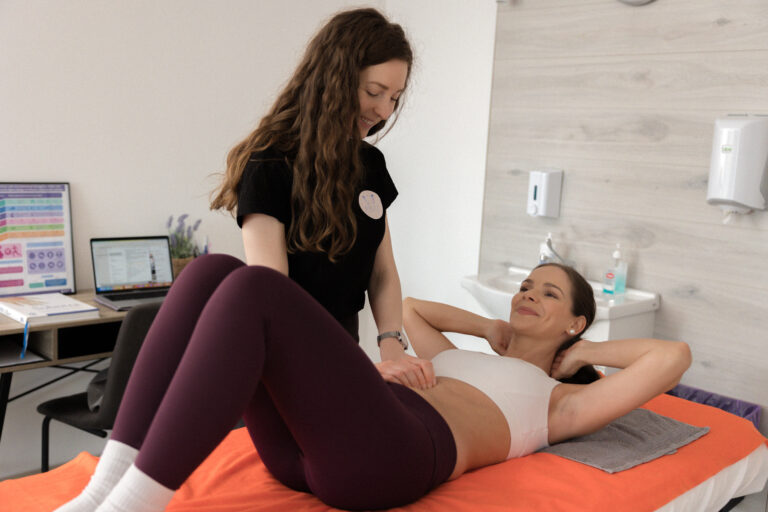
5. Functional assessment of pelvic floor muscles – recommended but not mandatory
The pelvic floor assessment includes visual inspection, palpation, and functional tests. It is always performed with the patient’s consent, in a discreet setting, and the patient may wear a medical skirt. Patients may be accompanied by a companion.
Patient positioning: usually lying on the side or supine with legs bent.
The physiotherapist first inspects the symmetry and skin condition of the perineal and anal area. If there are signs of skin injury or infection, the internal assessment is not performed.
During the assessment, the physiotherapist uses gloves and a small amount of lubricant to palpate the pelvic floor muscles internally, via the vagina or rectum, to assess baseline muscle tone.
Next, the patient performs various pelvic floor muscle activation tasks under the physiotherapist’s guidance.
The specialist evaluates:
● Muscle strength (1-5)
● Ability to relax
● Coordinated function
● Symmetry or possible asymmetry of muscle activation
The physiotherapist also monitors posture, diaphragm movement, and any involvement of accessory muscles.
Functional assessment includes evaluating pelvic floor muscle activation and coordination during daily activities, such as coughing, bearing down, or squatting, while continuing to
monitor reflexive and voluntary muscle function through palpation.
The patient can indicate at any time if they experience pain or discomfort, and the assessment can be stopped at any time.
6. EMG Pelvic Floor Biofeedback Assessment
The EMG pelvic floor biofeedback assessment is an objective method for evaluating the function of pelvic floor muscles.
The patient actively participates in the process. The examination is painless and takes place in a harmonious environment with the patient fully clothed. It can be performed on both adult women and men. If there are signs of skin injury or infection, the Biofeedback assessment is not performed.
The device allows the physiotherapist to assess:
● Baseline muscle tone of the pelvic floor
● Voluntary muscle activation
● Ability to relax
● Coordination of muscle contractions
● Possible involvement of the rectus abdominis
Important: EMG alone cannot assess left and right muscle function separately. Therefore, manual palpation and EMG biofeedback together provide a comprehensive picture of the pelvic floor. Both methods are important: manual assessment shows side-to-side differences,
tissue tone, and possible trigger points, while EMG provides objective visual feedback on muscle activity.
During the assessment, the patient receives real-time visual feedback on a monitor, seeing their pelvic floor muscles contract and relax. This supports conscious muscle control and learning correct activation.
EMG is not a treatment device; it is a learning and feedback tool to help the patient master correct muscle activation.
Each patient receives a new, sterile vaginal or rectal sensor. The patient goes to the bathroom and, following the rules of disinfection, independently attaches his/her own probe with electrode gel. They return to the treatment room fully clothed for the assessment described above. We recommend wearing cotton underwear for the examination.
The sensor is included in the assessment fee and can be used in subsequent biofeedback training sessions and re-assessment.
- Summary and Physiotherapy Plan